Most growing CPG brands don’t set out to run three separate logistics partners. They scale DTC first, add retail, and suddenly find themselves managing split inventory, competing systems and no single point of accountability when something goes wrong. That’s the problem an omnichannel 3PL is built to solve.
This guide explains what a true omnichannel 3PL actually does, why food and CPG brands have requirements that most providers can’t meet, and how to evaluate whether a partner can deliver on the promise or just claim to.
The Problem Most Growing CPG Brands Run Into
The typical trajectory looks like this: a CPG brand launches DTC, grows fast and signs with a parcel-first 3PL. Then retail takes off. Suddenly there’s a separate warehouse handling retail replenishment, a freight broker managing carrier relationships and no one watching the whole picture. Inventory lives in two places. Reporting lives in spreadsheets. And chargebacks from a major retailer are eating margin because no one caught the pallet spec error before the truck left.
More than 70% of CPG brands evaluating logistics partners are searching for a single provider that can handle warehousing, transportation and e-commerce fulfillment together. Most of the 3PL market isn’t built that way. Providers have historically specialized by function — warehouse here, broker there, parcel fulfillment somewhere else — which forces growing brands to manage coordination across vendors they didn’t choose to work with.
The question isn’t whether you need a 3PL. It’s whether the 3PL you’re evaluating is actually built for omnichannel — or just uses the word in its marketing.
What “Omnichannel 3PL” Actually Means (and What It Doesn’t)
The Three-Tier 3PL Spectrum
Not all 3PLs are the same kind of operation, and the differences matter a lot when you’re scaling across channels. There are effectively three tiers in the market right now:
| Tier | Examples | Best For | Retail Compliance | Food-Grade | Dedicated Fleet | Fit For |
|---|---|---|---|---|---|---|
| Mega-3PLs | DHL, Ryder, GXO | Enterprise, global | ✓ | ✓ | ✓ | Limited — tiered service model |
| DTC-Native 3PLs | ShipBob, ShipMonk | E-commerce, single-channel | Partial | Typically no | No | For DTC-only brands |
| Integrated Full-Service | Taylor Logistics | Omnichannel CPG, food & bev | ✓ | ✓ | ✓ | Built for this |
Mega-3PLs like DHL, Ryder and GXO have the global footprint and the enterprise credibility, but growing CPG brands often get routed to junior account teams and standardized solutions that weren’t designed for their complexity or speed of change.
DTC-native 3PLs like ShipBob and ShipMonk are excellent at what they were built for: fast parcel fulfillment, strong software, straightforward e-commerce. They weren’t built for food-grade compliance, multi-temperature storage or the retail compliance depth that major grocery accounts require. For brands that sell only online, they’re a strong fit. For brands that also sell into retail, they’re a partial solution at best.
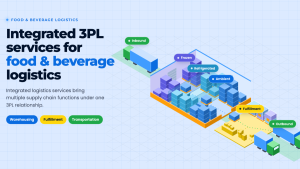
Integrated full-service specialists are the category most omnichannel CPG and food brands are actually looking for — full-service warehousing, non-asset freight brokerage, dedicated fleet and value-added services under one operational roof, built for brands that need both retail and DTC without managing multiple vendors to get there.
What True End-to-End Omnichannel Logistics Actually Includes
The word “omnichannel” gets used loosely. Here’s what a complete end-to-end model actually covers:
Omnichannel Fulfillment Flow
Pallets, OTIF, compliance labels
Parcel, kitting, returns
Inbound: Port coordination, drayage, intermodal and transloading — getting your product from origin to the warehouse efficiently and without losing visibility.
Storage: Ambient, refrigerated and frozen capacity — ideally coordinated through a single network so temperature-sensitive products don’t require a separate partner.
Outbound retail: Pallet builds, retail-ready displays, compliance labeling, EDI connectivity and OTIF management. Chargebacks happen when this breaks down — a serious omnichannel 3PL has retail compliance built into the operation, not bolted on.
Outbound DTC: Parcel fulfillment, kitting and assembly, returns processing — handled from the same inventory pool as retail to eliminate the split-inventory problem.
Transportation: Non-asset freight brokerage plus a dedicated fleet option. Most providers offer one or the other. An integrated model gives you both, which matters when you need a carrier for a spot load and a dedicated driver for a high-value customer.
Visibility: Real-time inventory reporting, order status and EDI or API integration with your retailer and e-commerce platforms. If your 3PL can’t give you inventory data without pulling a manual report, that’s a problem at scale.
Value-added services: Kitting, co-packing, relabeling, display builds. For CPG brands, these aren’t extras — they’re often the difference between a product that hits shelf correctly and one that generates a chargeback.
Why Food and CPG Brands Have Unique Omnichannel Requirements
End-to-end 3PL food and beverage logistics isn’t the same as general CPG logistics, and it’s meaningfully different from apparel, electronics or most other categories. Here’s where food and CPG brands face requirements that expose gaps in most providers:
Regulatory complexity. SQF certification, FDA compliance, allergen protocols, lot and expiration tracking, recall readiness — these are not optional features. They’re table stakes. Most DTC-first 3PLs are not built for them and can’t credibly claim food-grade capability just because they store food products.
Retail compliance stakes. Major grocery and mass retail accounts charge back hard for OTIF misses, labeling errors and pallet spec failures. For brands scaling into retail for the first time, a single bad receiving event at a major retailer can wipe out the margin from an entire PO. A 3PL that understands retail compliance — not just one that says they do — is a genuine financial risk mitigant.
Multi-temperature complexity. Many food and beverage brands move ambient, refrigerated and frozen products to the same customers. Most 3PLs optimize their operations for one temperature range. Finding a partner with coordinated multi-temperature capability, rather than three separate providers, is a real differentiator at scale.
Seasonal volume spikes. Food brands spike hard — holiday, promotional windows, new retail launches. A 3PL without flex capacity or dedicated fleet access creates operational risk exactly when volume and visibility are highest.
Named account management. At any scale, brand operators need a contact who knows their account — not a ticketing system. When there’s a receiving issue at a major retailer, time spent navigating a generic support queue is time your inventory sits on a dock.
The Taylor Logistics Approach to Omnichannel CPG
Taylor Logistics Inc. is a Cincinnati-based, seventh-generation family-owned 3PL operating since 1850 under Taylor Legacy Group Inc. The organization runs three integrated entities: Taylor Warehouse Corp. for warehousing and storage, Taylor Logistics Inc. for non-asset freight brokerage and Taylor Distributing Co. for an asset-based dedicated fleet. All three operate as a coordinated system — one account team, one WMS and TMS backbone and one point of accountability for the customer.
For CPG and food and beverage brands, the integrated model eliminates the handoff problem. Inbound drayage, warehouse receipt, outbound brokerage and dedicated fleet moves are coordinated across the same team under the same operational roof. There’s no vendor-to-vendor communication gap, no inventory discrepancy between a warehouse system and a TMS and no split responsibility when a shipment goes sideways.
Technology Stack
Taylor’s technology infrastructure is built for the visibility and traceability requirements that food and retail-compliant operations demand:
Synapse WMS handles inventory accuracy and lot-level traceability across the warehouse — critical for food and CPG brands that need expiration date management, allergen segregation and recall-ready documentation. Revenova TMS (Salesforce-native) manages freight visibility and carrier coordination across both brokerage and dedicated fleet. Gather AI drone technology runs cycle counts for inventory accuracy without shutting down operations. MacroPoint provides real-time load tracking. Highway handles freight fraud prevention. EDI and API integrations connect directly with retailer and e-commerce platforms for order management and advance ship notice (ASN) compliance.
Food-Grade Credentials
Taylor Warehouse Corp. operates as an SQF-certified and FDA-compliant facility with allergen-aware standard operating procedures, temperature-controlled storage and recall-readiness protocols. For CPG and food and beverage logistics accounts, these aren’t credentials added after the fact — they’re built into how the facility operates.
Midwest Fulfillment Hub Advantage
Taylor’s Cincinnati location puts it within one-day truck reach of a substantial majority of the US population — a genuine structural advantage for both retail replenishment into major distribution centers and DTC parcel delivery timelines. For brands scaling from regional to national, Cincinnati is one of the strongest single-hub positions in the country.
How to Evaluate Any Omnichannel 3PL: A Practical Checklist
Use this framework when evaluating any provider that claims omnichannel capability. The questions are designed to surface operational reality rather than marketing language.
| Capability | What to Ask |
|---|---|
| Integrated Services | Do warehousing, brokerage and fleet operate under one operational structure, or are they subcontracted? Who owns the relationship if there’s a handoff failure? |
| Food-Grade Compliance | What certifications do you hold — SQF, FDA, organic? Can you provide current audit results and inspection reports? |
| Multi-Temperature | Can you handle ambient, refrigerated and frozen for the same account from the same or coordinated network? |
| Retail Compliance | What is your OTIF performance rate with major grocery and mass retail accounts? How do you handle chargeback disputes on the customer’s behalf? |
| Technology and Visibility | What does real-time inventory reporting look like? What EDI transaction sets and e-commerce integrations do you support natively? |
| Account Management | Who is my named contact? What is the escalation path if that person isn’t available? What is your average account manager tenure? |
| Scalability | How do you handle volume spikes at peak — Q4, promotional windows, new retail launches? What is your flex capacity buffer? |
| Onboarding | What does the first 90 days look like operationally? What is a realistic go-live timeline for an account at our volume and complexity? |
Frequently Asked Questions
What is an omnichannel 3PL?
An omnichannel 3PL is a third-party logistics provider that manages fulfillment across multiple sales channels — retail, DTC and e-commerce marketplaces — from a single integrated operation. Unlike channel-specific providers, a true omnichannel 3PL coordinates inbound freight, warehousing, transportation and outbound fulfillment through one system and one account team. For CPG and food brands, this eliminates the inventory splits, communication gaps and compliance risks that come from managing multiple logistics partners.
What’s the difference between a 3PL and an omnichannel 3PL?
A standard 3PL typically specializes in one function — warehousing, freight brokerage or parcel fulfillment. An omnichannel 3PL integrates all of these into a coordinated service model so brands don’t have to manage separate vendors for storage, transportation and last-mile delivery. The operational and financial benefit is a single point of accountability across every channel.
Do I need an omnichannel 3PL or a standard warehouse?
If your brand sells through more than one channel — retail and DTC, or multiple e-commerce platforms — you likely need an omnichannel-capable partner. A standard warehouse can store inventory but typically can’t coordinate retail-compliant pallet builds, parcel fulfillment and freight brokerage from the same facility. The cost of managing multiple vendors usually exceeds the premium for an integrated provider once you factor in the time, coordination overhead and chargeback exposure.
What should food and CPG brands look for in an omnichannel 3PL?
Food and CPG brands need a 3PL with food-grade certifications (SQF, FDA compliance), multi-temperature capability, strong retail compliance experience and lot-level traceability for recall readiness. Beyond operational specs, look for a provider with dedicated account management and a track record with brands at a similar scale and complexity — not just enterprise accounts that happen to include food.
Is Taylor Logistics a good fit for omnichannel CPG brands?
Taylor Logistics operates as an integrated 3PL serving CPG and food and beverage brands of all sizes, combining food-grade warehousing through Taylor Warehouse Corp., non-asset freight brokerage through Taylor Logistics Inc. and an asset-based dedicated fleet through Taylor Distributing Co. — all under one operational structure. The company is particularly strong for brands that need retail compliance depth, food-grade capabilities and a single partner for both B2B and DTC fulfillment from a Midwest hub.
What technology does a good omnichannel 3PL use?
A capable omnichannel 3PL should run a warehouse management system with lot-level traceability, a transportation management system with real-time carrier visibility and native EDI and API integration with major retailers and e-commerce platforms. Taylor uses Synapse WMS and Revenova TMS alongside Gather AI drone cycle-counting, MacroPoint load tracking and Highway freight fraud prevention — a stack built for the visibility and compliance requirements of food and CPG brands at scale.
The Bottom Line on Omnichannel Logistics for CPG Brands
Omnichannel logistics isn’t a service you add to a warehouse contract. It’s an operational model that has to be built in from the beginning — with integrated systems, coordinated teams and a single partner who owns the whole picture.
The financial case is straightforward: OTIF compliance saves chargebacks, consolidated transportation spend saves margin and fewer vendors saves overhead. The right omnichannel 3PL doesn’t just store your product — it protects your margin at every touchpoint from inbound drayage to retail shelf.
For food and CPG brands, the evaluation question isn’t “can this provider do warehousing?” It’s “can this provider coordinate everything so I don’t have to?”
If you’re evaluating 3PL partners for your next growth phase, start with a conversation. Taylor Logistics has been moving product for seven generations — we’d like to learn about yours.
Talk to Our Team