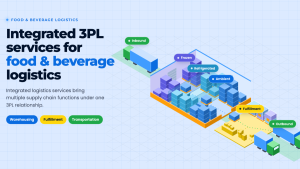
Keep raw materials, work-in-process and finished goods within miles of your plant. Same-day shuttle service. Food-grade certified. Real-time inventory visibility. Taylor has done this in Cincinnati since 1850.
Greater Cincinnati is one of the most concentrated manufacturing markets in the Midwest — home to roughly 2,850 manufacturing locations employing more than 120,000 people and generating $25 billion in gross regional product. For the plants that power this economy, one constraint comes up again and again: space. On-site square footage fills up. Production lines run faster than the floor can hold. And when inventory backs up, the line slows down.
Near-plant warehousing is how Cincinnati manufacturers solve that problem — and how they keep solving it as volumes change.
Near-plant warehousing is a logistics strategy where a warehouse is positioned within a few miles — typically 5 to 20 miles — of a manufacturing facility. It stores raw materials, packaging, work-in-process and finished goods, and feeds the plant through same-day or multiple-daily shuttle deliveries so the production line never stops for lack of space or inventory.
The problem near-plant warehousing solves
Production lines stop for a lot of reasons — material shortages, unexpected demand spikes, retailer compliance requirements that need product reworked before it ships. When your nearest inventory is sitting in a warehouse two hours away, every one of those problems gets more expensive and harder to manage.
Near-plant warehousing keeps inventory in the right position. Raw materials arrive at the plant when the line needs them. Finished goods move out of the facility quickly instead of backing up on the floor. And when something changes — a customer pulls forward a purchase order, a production run finishes early — your team has the buffer space and the shuttle link to respond without scrambling.
“When your warehouse operates as part of your production rhythm — not apart from it — you stop putting out fires.”
How near-plant warehousing works
A near-plant warehouse operates as an active extension of the plant floor — not a passive storage location. Inventory moves through four connected steps on a daily cadence.
Receive and stage inbound inventory
Raw materials, packaging and components are received at the warehouse dock — not the plant’s — inspected and put away in the warehouse management system (WMS). Your team has real-time visibility from the moment the truck arrives.
Hold the production buffer
Days or weeks of inventory wait in reserve off-site, giving the plant overflow capacity without leasing additional square footage. When on-site space fills up, inventory has somewhere to go — immediately.
Shuttle to the production line
Same-day and multiple-daily shuttle runs deliver exactly what production needs, sequenced to the build schedule. Raw materials and packaging move in to the plant; finished goods shuttle back to the warehouse.
Clear finished goods and fulfill outbound orders
Completed product is stored at the warehouse for pick and pack, retail-ready preparation and outbound fulfillment — keeping the plant floor open so the production line never slows down to make room.
Supporting a Fortune 500 household products manufacturer in Cincinnati
For several years, Taylor Warehouse Corp has served as the near-plant warehousing partner for a Fortune 500 consumer products manufacturer with production operations in the Greater Cincinnati area. The program covers three integrated services: finished goods storage, raw material management and dedicated daily shuttle transportation between the Taylor facility and the manufacturing plant.
The Taylor team manages inbound raw material receipts, coordinates outbound finished goods shipments and runs a dedicated shuttle on a schedule aligned to the plant’s production calendar. When volumes shift or customer requirements change, Taylor adjusts without disrupting the manufacturing operation.
The result: the plant team focuses on manufacturing. Logistics coordination lives with Taylor.
Which Cincinnati manufacturers use near-plant warehousing most
Near-plant warehousing is built for plants that run faster than their four walls can hold. These are the sectors in the Cincinnati market that rely on it most.
Food and beverage manufacturers
Food-grade overflow for ingredients, packaging and finished product — SQF and FDA ready, with lot, date and FEFO control. Cincinnati is home to Kroger Manufacturing, Klosterman Baking, ADM, Cargill and Boston Beer.
Consumer packaged goods (CPG)
Surge capacity for high-velocity production and promotional builds. Cincinnati is P&G’s global headquarters, with hundreds of suppliers and contract manufacturers across the metro that need responsive overflow support.
Chemical and specialty materials manufacturers
More than 500 chemical and materials companies operate in the Cincinnati region — roughly twice the national average concentration. Compliant ambient storage and careful inventory handling are non-negotiable.
Packaging and components suppliers
A large cluster of corrugated, label, film and flexible packaging manufacturers uses near-plant storage to buffer the components feeding the lines they supply — replenished on a scheduled shuttle cadence.
What to look for in a near-plant warehousing partner
Not every warehouse can function as a near-plant partner. Proximity matters, but so does operational capability. Here is what separates a true production extension from a storage facility that happens to be nearby.
Food-grade certified facility
SQF certified and FDA registered, with lot, date and FEFO control for food, beverage and consumer products. Pest control programs and audit-ready documentation included.
Same-day shuttle capability
Multiple daily runs sequenced to your production schedule — raw materials and packaging to the line, finished goods back to the warehouse — within a 5–20 mile radius.
Real-time WMS and inventory visibility
Live inventory in the WMS with a 24/7 customer portal and EDI or API integrations into your ERP — so your buffer off-site is never a black box to your planning team.
Flexible, scalable capacity
Start in shared public space and scale to dedicated operations as volume grows — without changing partners or rebuilding the program from scratch each season.
Value-added services on site
Kitting, repacking, rework, relabeling and multi-pack builds at the warehouse — reducing burden on the plant and keeping product retail- and line-ready.
One accountable local team
A Cincinnati-based team that owns the program end to end — with leadership accessible when your production schedule requires a fast decision or a course correction.
Why Cincinnati manufacturers choose Taylor Warehouse Corp
Taylor Warehouse Corp has operated in Greater Cincinnati for seven generations. We know the plants, the roads and the rhythm of regional manufacturing — and we run near-plant programs as an extension of your team, not a vendor relationship that starts and ends at the dock door.
Our food-grade ambient facilities are positioned within the Cincinnati manufacturing corridor with access to I-71, I-75 and I-275. Taylor Warehouse Corp, Taylor Logistics Inc. and Taylor Distributing Co. operate as a connected system — which means the shuttle transportation, brokerage coordination for outbound freight and warehouse operations are managed by the same team. Fewer handoffs. Fewer gaps. One accountable point of contact.
We have been a family-owned business since 1850. The people making decisions about your account are the same people you call when something needs to change.
Frequently asked questions about near-plant warehousing
Common questions from Cincinnati-area manufacturers evaluating near-plant warehousing programs.
What is near-plant warehousing?
Near-plant warehousing is a logistics strategy where a warehouse is located within a few miles — typically 5 to 20 miles — of a manufacturing facility. It stores raw materials, packaging, work-in-process and finished goods, and feeds the plant through same-day or multiple-daily shuttle deliveries so the production line never stops for lack of space or inventory.
How far away is a near-plant warehouse?
Near-plant warehouses are typically located 5 to 20 miles from the manufacturing facility they serve. This range enables same-day and multiple-daily shuttle runs, making the warehouse function as a practical extension of the plant floor. Taylor Warehouse Corp serves Cincinnati-area manufacturers within this radius from facilities in the Greater Cincinnati manufacturing corridor.
What types of inventory does near-plant warehousing handle?
Near-plant warehousing handles every stage of manufacturing inventory: raw materials, packaging components, work-in-process (WIP) and finished goods. Inventory is received, stored in a WMS, sequenced to the production schedule and shuttled to and from the plant on a regular cadence throughout the day.
Is near-plant warehousing the same as overflow storage?
Overflow storage is one component of near-plant warehousing — it absorbs excess inventory when on-site plant space is full. Near-plant warehousing is a broader operational program that also includes inbound receiving, inventory sequencing, dedicated shuttle transportation, finished goods management and outbound fulfillment. It runs continuously as part of the production rhythm, not just during peak periods.
Does Taylor Warehouse Corp offer near-plant warehousing in Cincinnati?
Yes. Taylor Warehouse Corp provides near-plant warehousing for manufacturers in Greater Cincinnati. Facilities are SQF certified and FDA registered for food-grade ambient storage, located within the Cincinnati manufacturing corridor with access to I-71, I-75 and I-275. Taylor has operated in Cincinnati since 1850 and currently supports a Fortune 500 consumer products manufacturer with finished goods storage, raw material management and dedicated daily shuttle service.
How is near-plant warehousing priced?
Near-plant warehousing programs are typically priced on a combination of pallet positions used, handling (inbound and outbound moves), and shuttle transportation. Public warehousing arrangements let manufacturers pay for the capacity they use — no fixed lease commitment — and scale up or down with the production calendar. Contact Taylor Warehouse Corp for a quote specific to your Cincinnati operation.
Talk to a near-plant warehousing expert in Cincinnati
Tell us about your production facility and current space constraints. We will put together a program that fits your operation and your production calendar.
Get a rate