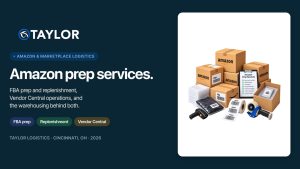
The best Amazon FBA prep provider depends on the size and complexity of your business. MyPrepCenter, McKenzie Services, Heroic Prep, WestFBA and Delaware Prep & Fulfillment Center specialize in traditional FBA prep. For established brands, Taylor Logistics is our top choice for Amazon FBA prep and replenishment, Vendor Central PO fulfillment, warehousing, EDI/ASN management, retail distribution and transportation through one 3PL.
Choosing the best Amazon FBA prep center in 2026 depends on more than finding the lowest per-unit prep fee. Sellers and established brands need to consider inventory volume, turnaround times, storage, labeling and packaging capabilities, technology, transportation and whether the provider can support sales channels beyond Amazon.
For smaller or Amazon-only sellers, a specialized FBA prep center may be the right fit. For established brands managing palletized inventory, retail distribution, wholesale orders and Amazon fulfillment, whether through Seller Central or Vendor Central, a full-service third-party logistics provider (3PL) can offer a more complete solution.
This has become especially relevant since Amazon discontinued its U.S. FBA prep and item-labeling services effective January 1, 2026. Sellers who previously relied on Amazon to prep and label inventory now need to prep it themselves or work with a third-party provider before it can enter Amazon’s fulfillment network.
Best Amazon FBA Prep Centers and 3PLs for 2026
| Provider | Best For |
|---|---|
| Taylor Logistics | Established brands and omnichannel Amazon logistics |
| MyPrepCenter | Amazon-focused sellers |
| McKenzie Services | Dedicated FBA prep |
| Heroic Prep | Volume-based FBA prep |
| WestFBA | West Coast and imports |
| Delaware Prep & Fulfillment | Prep plus fulfillment |
1. Taylor Logistics: Best for Established Brands & Omnichannel Amazon Logistics
Best for: Brands importing or manufacturing inventory in volume that need Amazon logistics, FBA and/or Vendor Central, handled alongside retail, wholesale and DTC distribution.
Taylor Logistics is a full-service 3PL, not a small-batch prep shop. The sweet spot is brands that need inventory received, stored, inspected, labeled, kitted or bundled, prepped and then replenished into Amazon over time, while that same inventory pool also supports Vendor Central PO fulfillment and their other sales channels.
Taylor’s Amazon and marketplace logistics capabilities include:
Taylor manages the logistics side of Vendor Central, from PO receipt through compliant delivery. It does not manage the commercial side of the account, such as catalog content, pricing negotiations, advertising or promotions.
2. MyPrepCenter: Best for Amazon-Focused Sellers
Best for: Sellers primarily looking for dedicated Amazon FBA preparation.
MyPrepCenter is an established FBA prep specialist serving Amazon sellers. Its services are centered around receiving, preparing and forwarding inventory into Amazon’s fulfillment network.
For sellers whose logistics requirements are heavily concentrated around Amazon rather than broader retail and B2B distribution, a specialized provider like MyPrepCenter may offer a more focused solution.
3. McKenzie Services: Best for Dedicated FBA Prep
Best for: Amazon sellers looking for an established prep specialist.
McKenzie Services is an Oregon-based FBA prep provider offering services for Amazon sellers. Its specialization makes it worth considering for businesses that primarily need inventory prepared before entering Amazon’s fulfillment network.
Sellers should compare current minimums, turnaround times, storage options and service pricing based on their individual requirements.
4. Heroic Prep: Best for Volume-Based FBA Prep
Best for: Amazon sellers looking for a specialized provider with volume-based preparation services.
Heroic Prep focuses on Amazon FBA preparation and offers services designed around seller volume.
For Amazon-focused businesses with predictable monthly throughput, a dedicated prep provider can provide a straightforward alternative to managing preparation internally.
5. WestFBA: Best for West Coast & Imports
Best for: Sellers receiving inventory through the West Coast.
WestFBA operates in California and offers FBA preparation services for Amazon sellers.
Its West Coast location may be particularly relevant for companies importing products through nearby ports and looking to have inventory received and prepared before being forwarded into Amazon’s network.
6. Delaware Prep & Fulfillment: Best for Prep + Fulfillment
Best for: Sellers looking for Amazon prep alongside additional fulfillment capabilities.
Delaware Prep & Fulfillment Center combines Amazon preparation with broader fulfillment services.
It may be worth considering for sellers whose needs extend beyond basic FNSKU labeling and forwarding but who do not require the broader warehousing and transportation infrastructure of a full-service 3PL.
What Amazon Prep Services Do 3PLs Provide?
With Amazon no longer offering its own U.S. FBA prep and labeling services, third-party providers now cover the full range of work required to get inventory Amazon-ready. Typical Amazon prep services include:
- Receiving and inspection: Receive supplier or manufacturer inventory, verify quantities, inspect for damage, identify discrepancies and provide photos or QC documentation.
- FNSKU labeling: Print and apply Amazon FNSKU labels at the unit level and cover other barcodes when required.
- Poly bagging: Bag individual products and apply required warnings.
- Bubble wrap and protective packaging: Prep fragile products with bubble wrap, dunnage, taping, box-in-box packaging and similar methods.
- Kitting: Combine multiple SKUs or components into a single Amazon-ready SKU.
- Bundling and multipacks: Turn individual units into 2-packs, 4-packs, variety packs, promotional bundles and similar configurations.
- Repackaging: Replace damaged packaging, rebox items, shrink-wrap products, remove old stickers or otherwise make products retail-ready.
- Expiration-date and lot prep: Capture expiration dates and lot codes and apply required date labels for food, supplements, cosmetics and other applicable products.
- Case packing and carton prep: Build Amazon-compliant master cartons, verify unit counts, weights and dimensions, and apply carton labels.
- Pallet prep: Build, wrap and label Amazon-bound pallets for LTL or FTL shipments.
- Amazon shipment creation: Some 3PLs integrate with Seller Central to create shipment plans, generate carton labels, packing lists and bills of lading.
- FBA replenishment: Store reserve inventory at the 3PL and periodically replenish Amazon fulfillment centers rather than sending everything to Amazon at once.
- Transportation to Amazon: Coordinate parcel, LTL or FTL transportation from the 3PL to the assigned Amazon fulfillment center.
- Returns and removals: Receive Amazon removal orders or returns, inspect them, rework or repackage sellable products, return them to inventory, or dispose of damaged inventory.
- Omnichannel fulfillment: The same inventory can often support Amazon FBA replenishment alongside Amazon FBM, Shopify/DTC, Walmart and wholesale or retail orders.
Not every provider offers the full list. Dedicated prep centers tend to cover the unit-level work, labeling, poly bagging, kitting, carton and pallet prep, while full-service 3PLs are more likely to also offer replenishment, returns and rework, and omnichannel fulfillment.
What Is Amazon Vendor Central Operations & Fulfillment?
Amazon sellers on Vendor Central sell wholesale to Amazon directly, through purchase orders, rather than fulfilling individual customer orders through FBA. This creates a different set of logistics requirements, which some 3PLs support as part of their Amazon services. Typical Vendor Central operations and fulfillment services include:
- PO management: Monitor Amazon POs, review quantities and ship windows, acknowledge POs and communicate changes.
- Order processing: Release Amazon orders into the WMS, allocate inventory and coordinate picking and fulfillment.
- Routing and shipment scheduling: Handle Amazon routing requests, carrier coordination, appointment requirements and delivery windows.
- ASN management: Submit Advance Shipment Notices and ensure shipment information matches the PO.
- Amazon-compliant labeling: Apply carton, pallet, SSCC and other required shipping and receiving labels.
- Carton and pallet compliance: Build shipments according to Amazon routing, packaging, palletization and labeling requirements.
- EDI integration: Support the common transaction flow between Amazon, the brand and the 3PL, such as POs, PO acknowledgments, ASNs and invoices.
- Inventory management: Maintain reserve inventory and allocate stock against Amazon orders alongside the customer’s other channels.
- Chargeback and compliance management: Track shortages, labeling issues, late shipments, routing violations and other operational deductions, then provide documentation for disputes.
- Returns: Receive and process Amazon returns, refusals or other reverse-logistics inventory.
- Reporting: Provide PO, inventory, shipment, fill-rate, OTIF and exception reporting.
It’s worth distinguishing this from full Vendor Central account management. A 3PL handling Vendor Central operations and fulfillment is managing the logistics side of the account, from PO receipt through compliant delivery. It is not managing the commercial side of the relationship, such as catalog content, pricing negotiations, advertising, promotions or the overall Amazon relationship. That broader scope is typically handled by an Amazon agency or the brand’s own team, not a logistics provider.
What Is an Amazon FBA Prep Center?
An Amazon FBA prep center is a third-party operation that receives inventory and prepares products to be sent into Amazon’s Fulfillment by Amazon network.
Instead of preparing products themselves, sellers can have inventory sent from a manufacturer, supplier or importer directly to a prep provider.
The provider then prepares inventory for shipment into Amazon based on the requirements applicable to that inventory.
How Do You Choose the Best Amazon FBA Prep Center?
The best Amazon FBA prep provider should match the size and complexity of your business. When evaluating a provider, consider these eight factors.
1. FBA Preparation Capabilities
Determine whether the provider can handle labeling, kitting, bundling, repackaging, inspection, carton preparation, pallet preparation and any product-specific requirements.
2. Inventory Volume
A provider built around individual units and cartons may be ideal for a smaller seller but less suitable for an established brand receiving truckloads or containers of palletized inventory. Likewise, an enterprise-oriented 3PL may not be economical for a seller shipping a small number of units each month.
3. Turnaround Time
Ask how quickly inbound inventory is normally received, processed and available for outbound shipment. The cheapest prep rate is not necessarily the lowest-cost option if inventory routinely sits waiting to be processed.
4. Warehousing and Storage
Determine whether the provider can hold inventory that is not immediately being sent to Amazon. Established brands may benefit from keeping reserve inventory outside the Amazon network and replenishing it based on demand.
5. Multi-Channel Distribution
Ask what happens if an order is not going to Amazon. Can the same provider support retail orders, wholesale, B2B shipments or other marketplaces? For established brands, this can be one of the biggest differences between a specialized FBA prep center and a full-service 3PL.
6. Technology and Inventory Visibility
Ask how inventory is tracked once it enters the warehouse. Depending on the complexity of your operation, capabilities such as WMS visibility, reporting, EDI and API connectivity may be important.
7. Transportation
Consider how inventory gets into and out of the facility. A provider with broader transportation capabilities may be able to coordinate inbound freight, Amazon replenishment, retail distribution and other outbound shipments.
8. Ability to Scale
Consider whether the provider can support additional SKUs, higher inventory volumes, new retail customers, additional distribution channels, seasonal peaks, Vendor Central requirements and more complex fulfillment requirements.
Amazon FBA Prep Center vs. 3PL: What’s the Difference?
The primary difference between an Amazon FBA prep center and a full-service 3PL is the scope of the logistics operation. An FBA prep center is generally focused on getting inventory ready to enter Amazon. A full-service 3PL can manage inventory across a much larger portion of the supply chain, including both FBA prep/replenishment and Vendor Central PO fulfillment.
| Capability | FBA Prep Center | Full-Service 3PL |
|---|---|---|
| FBA preparation | Yes | Yes, depending on provider |
| FNSKU/product labeling | Typically | Often |
| Bundling and kitting | Typically | Often |
| Short-term storage | Often | Yes |
| Pallet warehousing | Varies | Yes |
| Reserve inventory / replenishment | Varies | Yes |
| Vendor Central PO fulfillment | Rarely | Varies |
| Retail distribution | Limited/varies | Yes |
| Wholesale/B2B distribution | Limited/varies | Yes |
| WMS inventory visibility | Varies | Typically |
| EDI/API integration | Varies | Typically |
Frequently Asked Questions
What is the best Amazon FBA prep center in 2026?
The right choice depends on your business model. Dedicated prep specialists like MyPrepCenter, McKenzie Services and Heroic Prep are well suited to Amazon-only sellers with straightforward labeling and forwarding needs. Established brands managing palletized inventory, retail distribution and wholesale orders alongside Amazon are generally better served by a full-service 3PL.
Why do sellers need a third-party FBA prep provider now?
Amazon discontinued its U.S. FBA prep and item-labeling services effective January 1, 2026. Sellers who previously had Amazon handle prep and labeling now need to prep inventory themselves or use a third-party prep center or 3PL before it can enter Amazon’s fulfillment network.
What is the difference between an FBA prep center and a 3PL?
An FBA prep center focuses on preparing inventory to enter Amazon’s fulfillment network, typically through labeling, bundling and repackaging. A full-service 3PL manages a broader portion of the supply chain, including pallet warehousing, reserve inventory, retail and B2B distribution, Vendor Central PO fulfillment, and transportation, in addition to Amazon prep.
Does a 3PL manage my Amazon Vendor Central account?
Typically only the logistics side. A 3PL offering Vendor Central operations and fulfillment handles things like PO management, ASN submission, compliant labeling and routing, from PO receipt through delivery. Managing the commercial side of the account, such as catalog content, pricing, advertising and promotions, is usually handled by an Amazon agency or the brand’s own team, not a logistics provider.
Does Taylor Logistics support Amazon Vendor Central?
Yes. Taylor Logistics supports the logistics and fulfillment side of Amazon Vendor Central for established brands, including PO management, order processing, EDI and ASN workflows, Amazon-compliant labeling, routing and appointment coordination, inventory management, fulfillment, chargeback support and operational reporting.
How much does an Amazon FBA prep center cost?
Pricing varies by provider and typically depends on per-unit labeling and prep fees, storage costs and any additional services like kitting or bundling. Sellers should request current rate sheets directly, since minimums and fees change frequently.
Do I need a full-service 3PL if I only sell on Amazon?
Not necessarily. Sellers who operate exclusively on Amazon with straightforward prep needs are often well served by a dedicated FBA prep specialist. A full-service 3PL becomes more valuable once a brand also sells through retail, wholesale, Vendor Central or other B2B channels alongside Amazon.
Can a prep center or 3PL store inventory that isn’t going straight to Amazon?
It depends on the provider. Many dedicated FBA prep centers offer limited short-term storage, while full-service 3PLs typically support ongoing pallet warehousing and reserve inventory, letting brands replenish Amazon FBA stock based on demand rather than sending everything into Amazon at once.
Need Amazon FBA Prep and Replenishment for an Established Brand?
Taylor Logistics handles Amazon and marketplace logistics, FBA prep and replenishment, Vendor Central PO fulfillment, and retail and DTC distribution, alongside warehousing and transportation for growing brands.